
Equipment
RDT
Rotating Drum Thickener
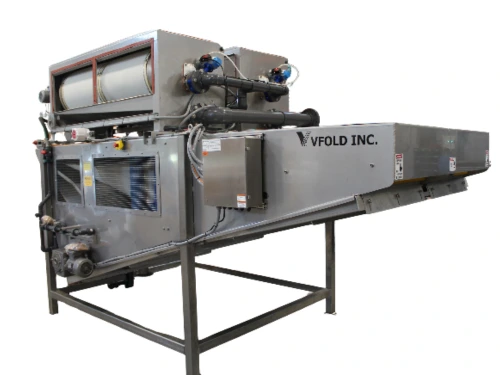
The Rotating Drum Thickener (RDT) is an innovative ‘sludge thickening’ system that improves the dewatering capabilities of slurries/sludges with low solids concentration, typically 0.35%DS to >1%DS.
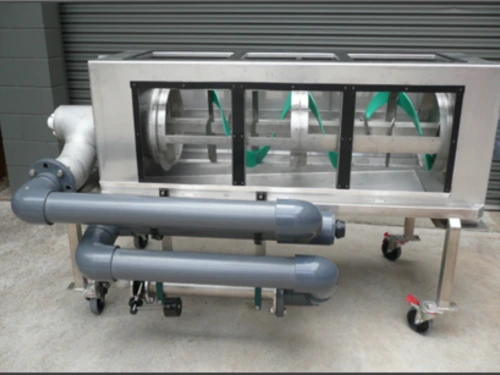
The RDT uses the principal of gravity drainage through a porous filter fabric. Feed slurry is conditioned with polymer through a mixer and flocculator before entry into the drum. Water is sprayed from the spray bar nozzles, continuously cleaning the filter fabric to prevent it from ‘blinding’. Positive displacement of the feed slurry, created by a spiral flight, moves the slurry across the filter fabric. Slurry is turned and rolled as it travels along the drum removing free liquid and increasing solids concentration.
Highlights
- The rotating drum thickener concentrates dilute slurries for volume reduction and solids concentration ahead of dewatering equipment or off-site disposal.
- Its simple, slow-moving design captures solids and converts them into thickened sludge.
- It is intentionally designed for integration with the V-FOLD belt press, but can also be used as a stand-alone process.
- Suitable for municipal and industrial applications, often applied after lamella clarifiers, biological treatment, and dissolved air flotation.
KEY APPLICATIONS:
- Municipal waste
- Sewage
- Wineries
- Slaughterhouse
- Food & Beverage
- Tanneries
- Metal finishing
- Printers
- Paper & cardboard manufacture
- And many more industrial applications
KEY ADVANTAGES:
- Adaptable to variable slurry feed characteristics
- Simple to maintain with low maintenance costs
- Low capital cost
- Gentle flocculation process reduces chemical consumption
- Small footprint
- Low energy consumption
- Self cleaning continuous operation
- Corrosion resistant materials used throughout
- Easy to install
Gallery
Data Sheets & Product Support
For detailed specifications, datasheets, and configuration guidance, please contact the V-FOLD team. We can help with sizing, automation options, and ancillary equipment selection.